
Part one was about the mental models running through your training. This one turns the camera around.
Most gyms don't tell you how the business behind the coaching actually works. I think that's a mistake. You trust us with your body a few times a week, so you're entitled to know how we think. And honestly, the models are the same ones from part one, just pointed at different decisions.
Five of them, and where they show up.
1. Constraints as an advantage
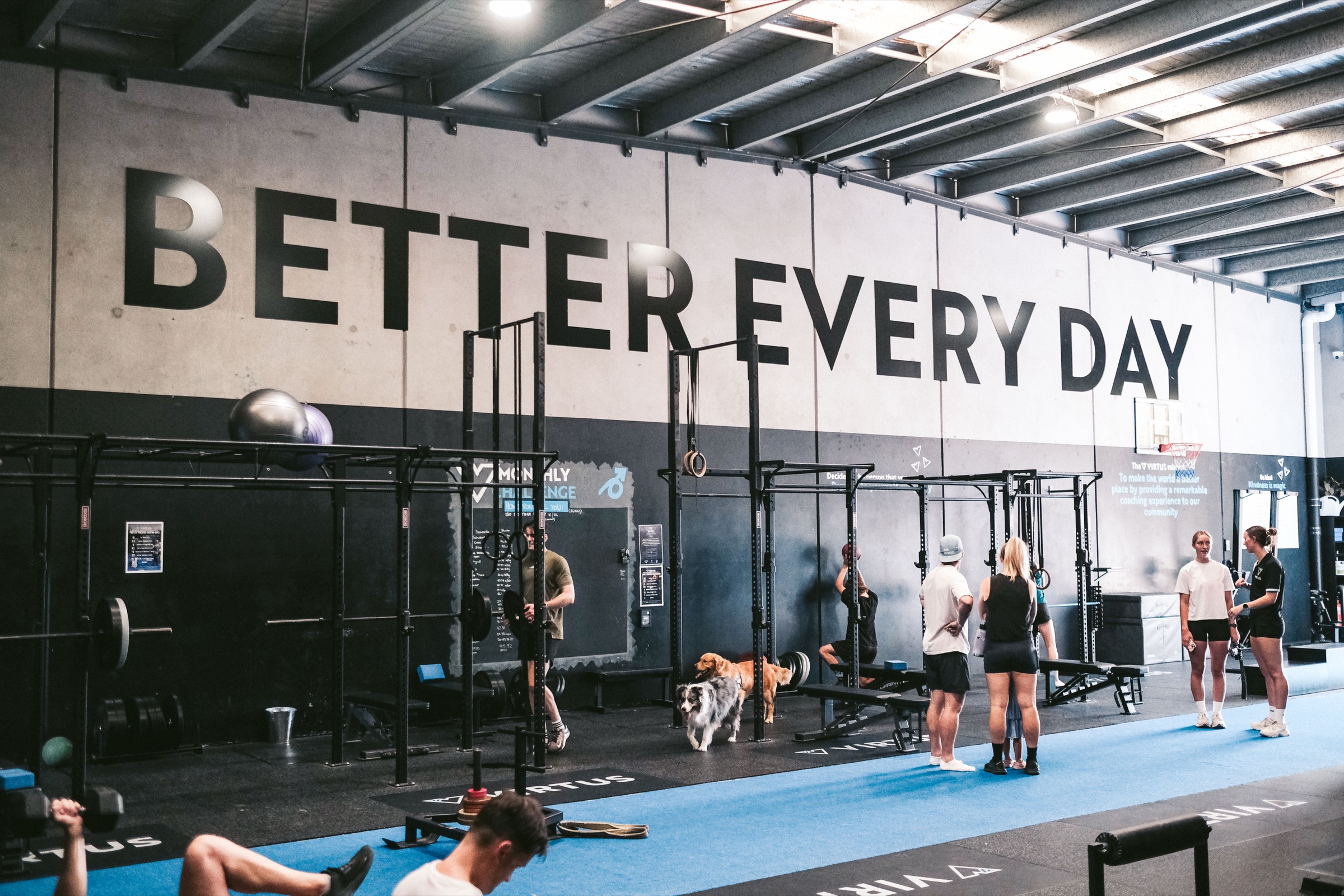
Every Session at Virtus is capped at eight people. We could fit more on the floor. We don't, because eight is the number where a coach can actually coach every person in the room, not supervise a crowd.
Same logic one level up: we deliberately cap how many members Virtus takes on. Growth for us doesn't mean more bodies through the door. It means going deeper with the people already here: better coaching, better results, longer athletic lives.
Most businesses treat constraints as problems to engineer away. We treat the right constraint as the product. The cap is not what limits the coaching. The cap is what makes it coaching.
2. Opportunity cost
Every yes is a no to something else. A business that says yes to everything has, without noticing, said no to being great at anything.
This is why Virtus doesn't run a cheap open-access membership, even though it would be easy money. Every hour of coach attention that isn't spent coaching is the real price of every side project, and coach attention is the scarcest thing we have. It's also why programs get retired. If something we run stops earning its place, it goes, not because it failed, but because whatever it was costing had somewhere better to be.
When we say we compete on coaching quality and never on price, that's not a slogan. It's an opportunity cost decision we re-make every time something shiny comes along.
3. Incentives
Show me the incentive and I'll show you the outcome. It's an old line because it keeps being true.
So we try to design Virtus so that the easy thing and the right thing are the same thing. Every Session is coached, so nobody is quietly left to flounder on their own. Onboarding is one on one and it's mandatory, no exceptions, because the incentive of a fast sign-up will always tempt a business to skip the foundations, and skipped foundations become injuries and quiet exits six months later. We'd rather make the start slower and the next decade better.
And your coaches are paid to coach, not to sell. When someone at Virtus suggests something to you, the incentive behind the suggestion is your long game. That's a design choice, not a personality trait.
4. Inversion, again
In part one, inversion meant avoiding the handful of things that reliably wreck training. For a business, the question becomes: what would kill this place?
Not slow growth. Not a quiet month. What kills a coaching business is members leaving faster than they arrive, for reasons nobody noticed in time. So the machinery of Virtus points hard at retention. Being known by name isn't a warm slogan, it's the early warning system. A member who drifts gets a human check-in, because by the time someone formally cancels, the real decision happened weeks earlier.
The inverted logic reaches the front door too: the best marketing we will ever do is a member who has been here ten years and tells their mates why. Everything else is rented attention.
5. Circle of competence
Know what you're actually good at, stay inside it, and be honest about the edges.
Virtus is a coaching business. Strength and conditioning, athletic development, the long game. That's the circle. Physiotherapy, osteopathy and psychology matter enormously to that long game, which is exactly why we don't pretend to do them. The allied health practitioners in our building run their own independent practices. We refer to people who are inside their own circle, rather than stretching ours until it tears.
The model cuts the other way as well. Inside the circle, we back ourselves completely. Outside it, the strongest move is a referral and no ego about it. Zero ego applies to the business too.
The thread through all five
Every model above is really one commitment wearing five outfits: the long game beats the short game, every time they conflict.
Virtus started in 2014. Our best year so far was the eleventh one. That's not a coincidence and it isn't luck. It's compounding, the first model from part one, working on a business instead of a barbell. Small, unglamorous, correct decisions, stacked for over a decade, most of them invisible in the month they were made.
Part three is the one I'm most interested in writing: taking these tools out of the gym entirely. Your work, your family, your next 50 years.
Wallace.